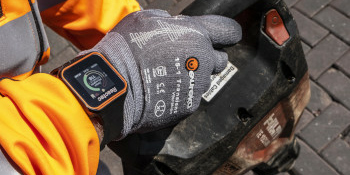
A monitoring system which is used to monitor daily exposure of vibration from tool usage is reliant on the owner of the system using it responsibly. In order to be compliant to regulations regarding the control of vibration at work, to use a vibration magnitude during the exposure monitoring which is representative of that particular tools current use.
The standard ISO5349 sets out how to develop an assessment of daily vibration exposure risk from one or multiple tools by combining the time on the tool(s) with the vibration magnitude(s) of the tool(s). An appendix to ISO5349 gives details of how the vibration magnitude of a tool is determined using a triaxle accelerometer mounted on the tool and applying an established frequency weighting curve.
Complying with the appendix is generally undertaken on a bi-annual basis and for a limited use of the tool. Therefore any devices or systems which produce daily HAV exposure points data for the use of multiple tools in a day is compromised by the validity of vibration magnitude data used by that device in relation to the actual use of the tool(s) in that day. Certainly none could purport to being fully compliant to ISO5349 as the instrumentation which does assure full compliance to ISO5349 and ISO8041 require a trained technician to supervise use and are intrusive to the tool operator under real use. The difficulties in the application of ISO5349 during every day use is the reason why HSE guidance does not require that a tool be measured to ISO5349 in order to develop a risk assessment. Rather the emphasis is put on establishing a vibration magnitude which is representative. There are a number of daily exposure monitoring systems which comply with the HSE guidance in the calculation of daily HAV exposure points based on trigger time and a static vibration number, including Reactec’s HAVWEAR (TEP) data, but all rely on the duty holder being in control of an appropriate selection for the static vibration data.
Due to the issue of obtaining a representative tool vibration value of actual tool usage in the field, Reactec invented HAVWEAR to not only rely on typical vibration magnitude but to also track vibration magnitude experienced by the wearer in real-time and over the period of a tools use. By obtaining the vibration experienced by the tool user, it could be argued that the HAVWEAR exposure data is challenging the appropriateness of accepting a static vibration data for the tool and perhaps yielding a more representative assessment of the risk.