Implementing only what the HSE specifies does not always provide the best financial return for your business. Apart from an employer’s legal requirements, HAV management is often seen as an overhead to offset risk and not as a potential cost saving opportunity.
A paper based HAV monitoring procedure is the standard practise for recording and monitoring operator exposure. The perception of companies who use a paper based system to manage Hand Arm Vibration is that paper is a low cost option, in-line with HSE guidelines and easy to setup and manage. Everyone also understands how to use a pen and paper so training will be kept to a minimum.
This method however has proven to be quite the opposite.
Monitoring HAV exposure across the workforce has created an administrative burden of considerable proportions. Keeping records of the time each employee spends on vibrating tools by asking them to fill in paper log sheets is problematic and somewhat cumbersome. Partly because of the nature of the industry it makes it impossible for a tool operator to do more than provide a rough guess of their tool usage.
Vague estimates contribute to somewhat spurious calculations, compromising the validity of the time and money spent collating and processing the information gathered. This lack of accuracy exposes the company and operator to an occupational health risk. As stated by Roy Jackson, Senior Safety Advisor at BAM Nuttall that “In the past, we were trying to accurately estimate the amount of vibration that staff were exposed to ourselves, but this was a lengthy and time-consuming process and we knew that we needed a better system” and Paul Fleetham, National Contracting Director at Tarmac also states that “paper based systems never really worked” for them.
Streamlining HAV management with a more efficient, accurate and effective solution can deliver cost savings from administration overheads, reduction in insurance premiums and offer improved workforce efficiency and tool utilisation. In fact some clients have increased workforce efficiency by up to 25% through accurate record collection and reporting.
To explain further; Lower administration costs are achieved by removing the need for operators to complete log sheets. The automated collection and compiling of data thus assists management in the time spent converting data and creating reports to monitor operator exposure levels. H&S audits clearly indicate problems with the paper system – for example, operatives do not complete the log sheets, write the same information daily or simply copy a colleague’s exposure record. Operators also over estimate tool usage up to 80%, limiting their ability to use tools which can prolong project completion dates. With inaccurate data, H&S Managers cannot effectively manage HAV and exposes a company further to litigation risk.
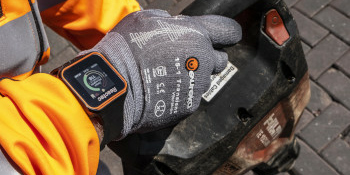
The HAVmeter solution automatically stores data on operator trigger tool time, tools used and vibration points accrued. This data is easily transferred to a PC for instant Vibration Exposure reports for easy, effective and accurate HAV management.
Gerry Kennedy, Roads Manager at AMEY North Lanarkshire said “Before the HAVmeter, we relied on manual input, with a guy basically using his memory at the end of the day for the time that he has spent using vibratory tools. With the HAVmeter, we have an accurate, user friendly piece of kit which allows us to manage HAV more easily. It really is a Health and Safety Management tool. We have been able to make major savings through cutting out administrative costs.”
Hidden Costs?
Paper based monitoring is a constant overhead and compared to the HAVmeter solution proves to be the more expensive option over time. Here’s a typical cost comparison guide to measure a paper and HAVmeter monitoring solution. The business case example detailed below is based upon a company with 100 operatives that are regularly exposed to vibrating tools. They are operating a manual paper based system compared with all the required HAVmeter equipment and software to support the suggested workforce.

The return on investment for this example is 11 months until paper becomes more expensive in real terms than the HAVmeter solution.
Further Cost Savings To Be Considered.
- Reduced tool allocation
- Reduced tool maintenance cost
- Reduced tool training cost
- Improved workforce efficiency
- Cost of claim defence
- Lower insurance premiums
- Support on tendering success through the PQQ process
- Damage to company image
Business Case Assumptions
The following assumptions have been made in the production of the business case;
- Each operative spends 15 minutes per day recording exposure time / points
- Supervisor(s) spend 2 hours per week checking operative submissions
- Administrator(s) spend 4 hours per week inputting operative data into spread-sheet
- H&S Manager spends 1 hour per week reporting & auditing activities
- Average hourly rates assumed for Operative, Supervisor, Admin Staff, H&S representative
- There are 48 working weeks per year
- HAVmeter estimated running costs have been made in estimating the on-going costs of the HAVmeter system;
HSE research indicates that it costs a company £7000 – £36000 to process every £1000 paid out in claims. A significant proportion of this cost is a consequence of both the quality and the difficulties in extracting historical information from past paper based assessments in different formats.
In summary the HAVmeter solution not only covers its costs as a best practise HAV management solution but also financially improves workforce efficiency, asset management and reduces legal costs to defend a claim.