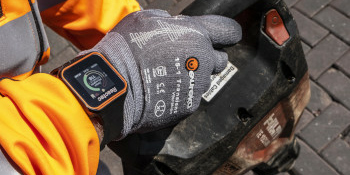
In today’s tightening margins, companies looking to cut costs, yet reduce risk and improve business growth should move their Hand-Arm Vibration Syndrome (HAVS) risk management into the digital age. For a company to suggest they only need to follow regulations and the use of digital technology is not required does not follow improvement logic, common sense or good business acumen.
It is globally recognised that to manage an effective business timely monitoring is required to support continuous improvement.As with all business systems, you want to know what is happening in your organisation at the moment rather than at some point in the past. The same should apply to managing health & safety risks and there has been some progress in the rail sector with the High Speed 2 (HS2) project recently producing a plan for Hand-Arm vibration (HAV) welfare that can only be practically supported by digital technology.
The proposedHS2 project will be the UK’s largest infrastructure project creating high speed rail links from London, Birmingham, Manchester and Leeds. The project is expected to offer a staggering £11bn of major works civil engineering contracts which raises the need for consistent safety standards from the beginning.
HS2’s new occupation health standards document – W1 1150 Occupational Health – was issued to ensure a standard safety culture is created. This is extremely significant for the industry as it sets a clear benchmark for health standards on major construction projects going forward and demonstrates the HS2’s clear commitment. It contains a continuous improvement process of timely monitoring to continuously reduce risk .
Emma Head, the Corporate Health and Safety Director for HS2, commented on this stating that the “focus over the last 12 months has been to define what this means in reality for HS2 Ltd and for our contractors, through identifying our clear, measurable health and safety commitments so we can articulate the legacy we will leave for health and safety.”
The particular area of interest in this document is the importance it places on the recording and continuous reduction of personal health exposure for their ‘Passport Scheme’. The key word here is ‘personal’. This is very important as a manual system would require extensive processes to be put in place and is proven to deliver a high level of inaccuracy. This is where deploying a digital monitoring system makes sense to practically and more accurately record the personal health exposure of individual workers with the industrial disease Hand and Arm Vibration being the highest ranked health condition in the rail sector, it is all the more important.
There are many systems for sample measuring a tools vibration but at the end of the day, this cannot practically or cost effectively support a continuous reduction process. So how can Contractors as stated in the HS2’s new occupation health standards document for individuals “implement appropriate control measures and undertake detailed monitoring to evidence their achievement”.Sample measuring also cannot assess real world tool use where vibration can vary greatly due to wear and tear of the tool or the tools accessories, the purpose for which the tool is being used or the skill of the tool operator. This impacts the accuracy greatly to evidence their achievements of risk reduction
Digital monitoring system provide a more practical approach to monitoring risk more consistently and efficiently to support the required continuous reduction of exposure. There is also monitoring technology, which is based on the person not the tool, to provide a more representative assessment of vibration risk experienced by a tool operator and, for the first time, the ability to understand what is actually happening during live tool use.
Edinburgh based Reactec has for a number of years been providing such a HAVS monitoring and management system to Network Rail and numerous rail sector companies.
Jacqui McLaughlin, CEO of Reactec says: “HAVS is preventable and it is essential that employers take this seriously as it is one of the most common industry diseases within the rail sector as stated recently by Claire Dickenson from the ORR, and the impacts are permanent and life changing.
Jacqui adds: “In terms of compliance, hand-arm vibration regulations are often treated like a goal to attain or a maximum level of achievement when actually it is the lowest standard to be in compliance. “Everyone with a knowledge of HAV exposure understands the significant variability in using manual tests. Only with a digital monitor such as ours can you have the insight to prioritise the major risk drivers.The HS2 recognize that for continuous improvement timely monitoring is required and as an individual’s exposure to HAV varies greatly each day it only makes sense to monitor daily”.
“Based on fact-based data instead of estimations our system makes assessing exposure and developing effective risk reduction activities more simple and efficient. It provides every director, manager and worker a far greater ability to recognise the risks in their operational activities and apply more effective and efficient measures of controls. Also for the first time, manage risks previously undetected by static and generic risk assessments for example inadequate operator training”.
In summary to deliver continuous improvement at an individual level a manual process is highly inefficient and inaccurate. Also with a highly variable daily exposure risk for any company wishing to achieve the HS2 occupational health standards, retain skilled workers and reduce wasted resources it makes common sense or good business acumen to augment digital monitoring technology into your health risk management policy.