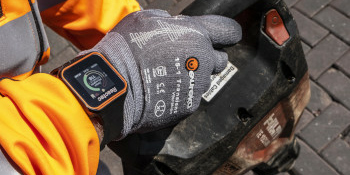
The following examples show issues highlighted by the HSE and how the Reactec Analytics Platform can address them.
Breaker manufacturer example is taken from the HSE web-friendly version of The Control of Vibration at Work Regulations 2005 Guidance on Regulations L140, page 58, case study 5)(Published 2005 – https://www.hse.gov.uk/pubns/priced/l140.pdf).
The Reactec example is taken from the Reactec Analytics Platform.
Operator training provided by a breaker manufacturer
A manufacturer of vibration-reduced pneumatic paving breakers made vibration measurements in real working conditions and found that the vibration exposures were highly dependent on the way the machines were operated. The company produced training material for its customers, which included the following points:
- select the correct cutting tool for the job (eg moil point/narrow chisel for concrete; straight-bladed cutter for asphalt) and keep them sharp;
- keep the handles in the horizontal position for lowest vibration (see images to the right);
- let the weight of the tool do the work and don’t grip too tightly;
- move the cutting tool every 8-10 seconds (the amount of concrete broken is about the same after 10 seconds as after one minute);
- stop the breaker when lifting it to change position because the vibration is high when pulling up on the handles;
- when cutting concrete, take small ‘bites’ to prevent the cutting tool jamming;
- remove concrete in shallow layers.
It was found that, when breaking concrete, untrained operators were lifting the breaker without switching off (so increasing the vibration), and were operating continuously for about a minute without moving the cutting tool. The average vibration was about 9 m/s2, which meant that the exposure action value was reached after about 35 minutes trigger time (35 penetrations of the concrete) and the exposure limit value was reached after about 135 minutes trigger time.
By training the operators to stop the machine before moving it, the average vibration was reduced to around 7 m/s2, allowing a 70% increase in the time before the exposure action and limit values were reached. Further training improved the operators’ techniques and the average vibration was reduced to approximately 5.5 m/s2, allowing about 100 minutes trigger time before reaching the exposure action value.
Also, by training the operator to stop and move the cutting tool after about 10 seconds of operating, instead of working continuously for about a minute, the amount of work done (concrete broken) was greatly increased. The training produced substantial reductions in the vibration exposures, and enabled the operators to use their tools more efficiently. Up to 17 times more concrete could be broken than before, without increasing the vibration exposures.
Case courtesy of Macdonald Air Tools Ltd https://www.hse.gov.uk/vibration/hav/campaign/construction/operatortraining.htm
How the Reactec Analytics Platform can help address unexpected levels of exposure
The chart below depicts the calculated maximum HAV risk exposure for each individual based on the actual trigger time and real-time vibration measurement when excavating one hole. Each tool operator was wearing a HAVwear device.
Based on a task based assessment with a minimum two operator team, the expected maximum risk would be 139 points. Reality is 5 out of 14 operators exceeded this level. Pete’s exposure was close to the HSE Exposure Limit Value and 6 times more than other colleagues tasked with the same duties.
This shows job rotation is unlikely to be followed as planned without monitoring and each operator is unique in technique and physicality which can lend itself to a high level of variability in exposure risk.
Conclusion
- All activity can have high levels of variability in exposure when using manual tools.
- These levels of variability challenge the validity of spot checks and sampling.