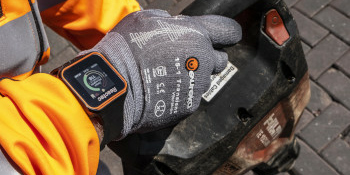
We use wearable tech every day in our daily lives, but there are benefits to using it at work too, according to an industry expert.
Keith Prince, health, safety and environment leader for infrastructure at Laing O’Rourke is an expert contributor to a new report which highlights the impact of Hand Arm Vibration Syndrome (HAVS), a debilitating and irreversible condition caused by exposure to vibration, from power tools, among other things.
300,000 people suffer from the condition in the UK, with another two million at risk, according to the HSE. 10% of workers who operate at what is known as the Exposure Action Value – which many consider a safe level – will develop the condition within 12 years. But, while regulations have been in place for many years on how to manage risk, HAVS was still the highest reported workplace illness in 2018.
Traditional assessments are often ‘one size fits all’, using static vibration magnitude data, often based on manufacturers’ declarations, or from a measurement at a single point in time, which requires a skilled technician to be on hand.
Data from these traditional assessments also fail to account for individual differences. The way people use tools, the intensity of the use and the condition of the equipment are all variables that can produce significantly higher levels of vibration than that assessed using static data . In one study of 14 operators undertaking the same task with the same tool, one user, Pete, had an exposure six times higher than some of his colleague. Static data assessment did not predict Pete’s individual risk, but real-time monitoring did.
The answer may lie in tech
One alternative is smart wearable monitoring technology. Laing O’Rourke uses it to plan tasks more effectively. The technology is particularly useful when workers are performing multiple tasks and using several tools for differing lengths of time.
“It’s almost like a Fitbit, it’s clocking his time irrespective of what he does today,” Mr. Prince says. “I would challenge anybody to be able to work that out using a spreadsheet or a piece of paper. You could argue that it is an essential risk control measure where people are multitasking throughout the day.”
Mr. Prince says the technology is “particularly beneficial if you have got high-risk work or people who are regularly in and around vibration. In those situations, it becomes too complex to do it manually”.
One difficulty in managing HAVS is correctly identifying when someone’s symptoms began. Mr. Prince points out that a problem might have started with a previous employer or even with a leisure activity such as riding a motorbike. The disease can take between six months and twenty years to develop, meaning employees may start work with an underlying latency. Again, wearable technology helps to assess the individual rather than the tool.
A study by Reactec analysed data from 4,000 tool operators who used its wearable technology over a nine-month period, compared with static methods of assessing risk. It discovered that for a fifth of individuals, static methods underestimated risk on average by 76 per cent.
The facts point to an urgent need for industry to go above and beyond in the fight against this debilitating condition.
Reactec has today launched a robust call for industry to go above and beyond in the fight against HAVS. A new report by leading journalist, Paul Wilkinson, ‘The Hidden Threat’ brings together evidence and human experience to create a compelling call for action which goes beyond the current recommended guidelines.
Join Reactec’s call to industry to do more to protect against the hidden threat of HAVS. Download the report here.
Find out more:
- Video – The Telegraph newspaper interview with Reactec on HAVS risk in the FM sector.
- Report – IOM report on the validity of the data produced by Reactec’s HAVWEAR to inform a suitable and sufficient risk assessment.
- Research – Determination of hand-transmitted vibration risk on the human (International Journal of Indutrial Ergonomics).