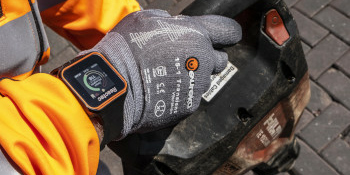
The Institute of Occupational Medicine (IOM) was requested by Reactec to conduct an independent review of data collected using the HAVWEAR system and subsequently provided a report in January 2018.
HAVWEAR collects two types of assessment data to be viewed online:
- It uses a tools pre-defined vibration magnitude and length of time the tool is in use to calculate exposure points in accordance with The Control of Vibration at Work Regulations 2005 and HSE guidance. Reactec name these types of exposure points as “Tool Exposure Points” (TEP).
- It also determines the vibration transmitted to the tool wearer’s wrist and mathematically corrects for the energy loss between the wrist and the tool grip point. HAVwear uses this determined vibration magnitude and the length of time the tool is in use to calculate exposure points relating to real-time vibration exposure experienced by the wearer. Reactec name these types of exposure points as “Sensed Exposure Points” (SEP).
The purpose of the report was to demonstrate if HAVWEAR's SEP data could be used: (1) to inform a suitable and sufficient risk assessment; and (2) in the development of risk reduction control measures.
The IOM report concludes:
- that data gathered by the HAVWEAR system provides a useful source of information to inform a suitable and sufficient risk assessment;
- that whilst the HAVWEAR system measures vibration experienced by a user rather than “on the tool” in accordance with the requirements of BS EN ISO 5349-1: 2001, HAVWEAR can provide ranges of vibration magnitude comparable to those produced by conventional measurement techniques;
- that data produced by the HAVWEAR system can inform a risk assessment that is realistic with respect to actual tool use;
- as the HAVWEAR system assesses vibration exposure during the entire use of the tool it may be more accurate than the use of trigger times and manufacturer’s data or other data sources compiled for a limited range of tool activity;
- that the data gathered by the HAVWEAR system on a regular basis can inform the development of risk reduction control measures and can be used to identify trends in risk reduction as part of a risk management program.
- that the HAVWEAR system has advantages over conventional means of vibration magnitude measurements
The IOM study was also requested by Reactec as an HSE FAQ published in early 2017 had been broadly misinterpreted in the market place to suggest that HAVwear should not be used. Reactec wanted the study to clarify where HAVWEAR was of benefit.
It is important to consider The Control of Vibration at Work Regulations 2005 and related ISO standards. The Control of Vibration at Work Regulations require employers, who carry out work which is liable to expose any of their employees to risk from vibration, to make a suitable and sufficient risk assessment and put in place controls to reduce the risk to as low as reasonably practicable. A risk assessment of hand arm vibration exposure requires an understanding of the duration of exposure to vibration and the magnitude of the vibration during tool use. Determination of the vibration magnitude that is relevant to the use of the tool is a significant practical challenge.
The international standard ISO5349 details how to calculate HAV exposure risk from the duration of a tools use and the tool’s vibration magnitude. It also defines how to combine the risk of multiple tool use within a single day against an action value and limit value threshold. HAVWEAR calculates daily exposure points as defined by the standard. In addition within an appendix to the standard, details are given on how to measure a tools vibration magnitude by attaching a triaxial accelerometer to the tool and applying a frequency weighting curve to the measured spectrum of vibration. HAVWEAR uses a novel methodology to determine a vibration magnitude which is comparable but not in compliance to that defined by the standard by applying an algorithm to the vibration measured at the wrist.
The appendix within ISO5349 and a related standard ISO8041 were developed to ensure consistency in the measurement of the vibration magnitude of tools. This consistency has ensured for example that tool manufacturers declare the vibration levels based on the same measurement technique and use of the tools. The challenge for a duty holder is to know whether this compliant measurement from the manufacturer or any other compliant measurement taken at a moment in time is relevant to their employee’s use of the tool.
The HSE recognise that in situation vibration can vary greatly for the same tool across it’s range of use and method of use. Also that the manufacturer’s declared data is often at the lower end of spectrum of use. Figures 1 and 2 below, taken from “The Control of Vibration at Work Regulations 2005 Guidance on Regulations, Page 64, section 216” illustrate the range of vibration for three different tool types as tested by the HSE. The average across all testing is shown by the mark to the right of the line, the manufacturer’s declared value in accordance with ISO5349 and ISO8041 (the harmonised test code) to the left of the line.
The HSE would see the use of the declared manufacturer’s data in the case of the impact drill below to be acceptable for a risk assessment, but not in the case of the other two tools. HSE expand on this in an “Appendix 3 Sources of Vibration Magnitude” that a value in the upper 75th percentile of use is suitable for a risk assessment.

Measuring a tool to the ISO5349 standard may be an expensive, intrusive process and not practical to apply in every day tool use. It is therefore accepted that other sources of data may be used for a risk assessment provided they are credible relative to established understanding. The IOM report was designed to study whether the data produced by Reactec’s HAVWEAR could inform a suitable and sufficient risk assessment, and concluded positively.
The study was designed in two stages:
- The IOM firstly reviewed data collated by Reactec from 23 tool onsite scenarios with up to 3 simultaneous test methodologies – HAVwear and two ISO5349 compliant instruments. Each tool was tested up to 30 times. The IOM statistically analysed the data for consistency and correlation.
- From phase 1 the IOM determined a range of tools to evaluate autonomously which would yield a broad spectrum of tool behaviour. The IOM undertook 477 independent tests of 40 tools covering 16 tool types. The work was carried out in real tool use environments including road maintenance, forestry & grounds maintenance, workshop, and garage repair shops. The aim of this phase was to consider the HAVWEAR as a risk assessment and/or a risk management tool.
Analysis of the findings from both phases of work were used to address some specific questions aimed at clarifying if the system’s information could inform a suitable and sufficient risk assessment and form part of a risk management program assessing the effectiveness of control measures.
While Reactec’s HAVWEAR product is unique as a wearable wrist worn device which determines a vibration level which can inform a credible risk assessment, it is worth being aware of the other product types on the market place and how they differ:
- There are a number of instruments which are used to calibrate a tool’s vibration magnitude to the ISO5349 and ISO8041 standards which require a trained technician to apply them appropriately. The test methodology using these instruments may be intrusive on the tool’s use and not practical to use over the extended use of the tool with the need to mount a sensor, attached to the instrument, directly and robustly on to the grip point of the tool. Typically used as a once or twice per annum tool test.
- There is at least one device which requires the sensor to be gripped by the tool user against the tool during normal tool use. Reactec would have concerns that the operator will be able to consistently hold the sensor against the tool. Any de-coupling between the sensor and the tool may cause the risk to be under assessed.
- Finally there are a number of trigger timer devices either wrist worn or placed on tools that have no ability to determine the vibration magnitude during use of the tool, simply the amount of time the tool is used. These devices calculate the HAV exposure risk points based on a static vibration magnitude which the duty holder must determine from another source and enter into the device. Often it is assumed that such products are compliant to ISO5349 because the exposure points are calculated following the standard’s methodology, in the same way HAVwear calculates TEP points. However the issue remains as to whether the static vibration data used in the calculation, albeit determined, at some point in time, in compliance to a standard, is suitable for the risk assessment being under taken for a particular use of the tool.