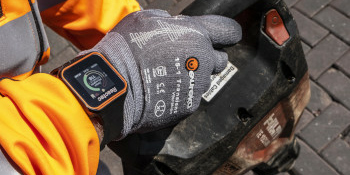
Investigating the utility of wrist worn vibration monitoring in the effective management of exposure to dangerous vibrations within the work place.
> Download the Whitepaper (PDF)
The paper seeks to define the value that data from continuous monitoring can have in forming an effective risk management process within the work place.
The paper also seeks to demonstrate the validity of vibration data acquired from a personal wrist worn vibration monitor in assessing exposure to hazardous Hand Arm Vibration.
Illustrated within the paper are some of the shortcomings arising from over reliance on single point sample measurements and the deviation between the perceived exposure calculated from a single point measurement and the reality of true exposure given the variability across time, task and a large cohort of individuals;
Assessing exposure
- The paper shows vibration generated from powered hand tools has intrinsically a highly variable mechanical property and tests taken in isolation are prone to being skewed by peaks or troughs incurred during the test which may not be indicative of typical vibration levels. The paper also illustrates that vibration exposures can vary up to 50% on the same tool, performing the same task. When this is coupled with additional variables such as operator proficiency, tool wear and different substrates this variance can be significantly higher still.
- Therefore it is almost impossible to fully capture the range of exposure conditions and operator proficiency at play across an organisation and also illustrates there is no typical working environment across many industries including manufacturing. A risk assessment will be required to take this into consideration but will be open to error when relying on sampled data as the resulting average exposure estimation is based on a limited timeframe which can never hope to capture all conceivable fluctuations in activity and behavior present within a real world environment.
- A conclusion from the whitepaper is any assessment of this property will increase in accuracy the greater the duration of measurement and cohort size which constant monitoring can provide by reducing the margin of error associated with estimation. Also the use of a single value to determine vibration exposure across all use is unlikely to be representative of the true exposure means there is an opportunity to improve on the status quo by providing a monitoring solution that does not rely purely on assumptions or estimations and can also track changes in behaviour, task and tool wear.
Accuracy of exposure data using a wrist worn device
- The paper validates a solid correlation of vibration exposure data gathered from a wrist worn vibration monitor against data acquired in compliance with the international standard ISO 5349..
- It is achieved by detailing a series of measurements which were taken concurrently (in the field and laboratory) using a wrist worn device (REACTEC HAVWEAR) and reference instruments (such as a Larson Davies and Bruel & Kjaer Photon +) configured in accordance with ISO 8041 and used in line with ISO 5349 measurement practices.
- Accurate correlation in the frequency domain is essential for hand arm vibration exposure assessment to ensure the overall dose is calculated correctly against the frequency weighting curve defined in ISO 5349 and that vibration generated at frequencies within the spectra of interest are transmitted through the wrist without being over or under attenuated. The tests provided extremely close correlation within the frequency domain to lend credence to the validity of determining vibration on the wrist as an effective way of assessing exposure to harmful vibration.
- In conclusion the paper indicates that measurements taken on the wrist can provide a strong correlation with vibration exposure.
Beyond ensuring exposure is kept within working limits in the short term, the ability to have real time continuous monitoring data which is traceable to tools, tasks and operator can aid significantly in the process of designing out exposure through identifying the source. Targeted procurement, process optimisation, improved tool maintenance and operator training are enabled through access to this data and can lead to significant reduction in exposure. The very nature of a wearable device that provides real time feedback to the operator can also facilitate behavioural change and a level of awareness that is not possible through periodic interventions.
Download the Whitepaper (PDF)