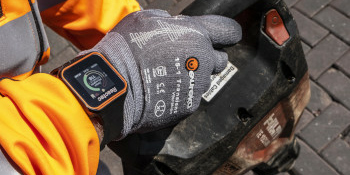
Involving workers in the establishment and enforcement of health and safety procedures is a simple and effective practice which makes good business sense. It is often the case that employees who face health and safety risks on a daily basis are best placed to suggest ways to guard against those risks. Stewart McNaughton, Health and Safety Consultant at Reactec – the UK leader in hand arm vibration management – makes a compelling case for the benefits of worker safety involvement.
The Law
While managers remain responsible for health and safety in the workplace, the law dictates that workers must be consulted on the practices in place. The relevant laws – The Safety Representatives and Safety Committees Regulations (1977) and The Health and Safety (Consultation with Employees) Regulations (1996) – are in place in order to guide the implementation and development of effective health and safety measures. Reviewing your arrangements on a regular basis will help to ensure legal compliance and avoid the costly consequences of improper management; the Health and Safety Executive and local authorities regularly make inspectional visits to the workplace and can impose significant consequences for failure to observe legal requirements.
Thankfully, these regulations do recognise the differences between large and small businesses where worker safety involvement is concerned. For larger companies, it’s often more efficient to appoint health and safety representatives or a health and safety committee to hold responsibility for health and safety matters. It’s also worth noting that different regulations on worker safety involvement apply to offshore installations.
Communication: a simple two-way process
Fundamentally, involving workers in health and safety practices requires two-way communication between employers and employees. Ensuring that you take on board feedback and ideas from your staff, as well as communicating your own intentions and the reasons behind them, will ensure a cooperative and collaborative approach, not just to health and safety procedures, but to working life in general. By giving your employees the opportunity to voice their concerns and suggestions, you’ll identify joint solutions to problems and guidelines that your workforce will more likely abide by, and in turn, demonstrate that you value the importance of team work. Ultimately, making communication a two-way process will improve relations between employers and employees.
It’s strategic: business benefits
A happier, healthier and safer workforce will be far more engaged in the job and you’ll reap the benefits of improved performance and productivity, quality and efficiency. A balanced and well thought out health and safety procedure should result in weighty cost savings from fewer accidents at work, as well as a reduction in unnecessary absence and ill health. Anecdotal evidence suggests that businesses practising worker safety involvement receive significantly fewer claims for work-induced health problems, and this is most likely a direct result not only of exemplary health and safety procedures, but also of workers abiding by those procedures.
The business benefits of worker safety involvement are backed by research conducted by the Health & Safety Executive (HSE) , which states that “accident rates are lower where employees genuinely feel they have a say in health and safety matters (14%) compared with workplaces where employees do not get involved (26%)”. Additionally, “more than three quarters (77%) of employees surveyed felt encouraged to raise concerns in a good health and safety climate compared to 20% who felt encouraged to do so in a poor health and safety climate”, and “among employers, awareness of slips and trips is higher when there is employee involvement (62%), compared to where there is no involvement (28%)”.
Most importantly, if the results are visible from within the business, they’re likely to permeate into the wider industry too – you’ll preserve credibility with customers and industry experts, helping to position the business as an example of best practice.
It doesn’t have to be complicated
The effective management of risk in the workplace needs to be well thought out, but worker safety involvement does not have to be complicated. Some of the most successful outcomes of worker safety involvement result from simple practices such as creating a physical or digital space where employees can post or pin their suggestions, or meeting at regular intervals to discuss concerns. The best outcomes of worker safety involvement, though, result from practices that go above and beyond simply sharing information about management proposals and manifest as visible amendments to policy and procedure. As the HSE recommends – plan, prepare, consult and improve. That is, plan your health and safety policy within the guidelines of the law, prepare clear and practical guidelines on how it will work, consult your workforce and carefully consider their input, then revisit the idea again and improve on what you had. Continuously revisiting this cycle is a sure-fire way of ensuring best practice for health and safety, no matter what industry you operate in.
Stewart McNaughton
Stewart McNaughton is Health and Safety Consultant for Reactec Ltd, the UK leader in hand arm vibration management. Reactec’s device for measuring and monitoring vibration emissions – the HAVmeter – maintains worker involvement in managing HAVs risk, increasing accuracy compared to traditional paper-based systems and illustrating commitment to worker wellbeing.