The subject of managing employee potential harm from exposure to vibration through the hand and arm (HAV) is not helped by information being published from organizations which focus on what is not possible with technology such as wearable devices or who tend to misquote the regulations or take pieces of HSE guidance in isolation.
Reactec would rather inform the market on what must be considered in order to manage your organisation’s and your employee’s potential harm. To give the subject greater clarity the following points should be considered. With each point Reactec have endeavored to reference further reading material for concerned employers to review
- Measurement of a tool’s vibration magnitude to ISO5349 is a test process which requires instrumentation from companies such as Larson Davis and Svantek which are regularly calibrated and operated by a trained technician. The process typically involves taking a measurement for 1 minute’s use of a tool, repeated three times, to create an average vibration of the three measurements. Despite the accuracy of this process there remains a risk that the test conditions may not reflect your future use of the tool by your varied work force. See HSE L140 para 123 page 38.
http://www.hse.gov.uk/pubns/books/l140.htm - The Control of Vibration at Work Regulations 2005 do NOT require that a tool vibration measurement be undertaken in compliance with ISO5349 in order to assess the risk of exposure to HAV. Specifically, the regulations state that an assessment requires “the probable magnitude of vibration”. See the regulations.
http://www.legislation.gov.uk/uksi/2005/1093/contents/mad - The HSE L140 guidance does NOT mandate that a measurement of a tool’s vibration needs to be taken in order to carry out a suitable and sufficient assessment of exposure to HAV. See HSE L140 para 29, 33, 35, 38,112, 113, 122.
http://www.hse.gov.uk/pubns/books/l140.htm - A tool is capable of emitting a broad range of vibration magnitudes depending on the condition of the tool and it’s accessories, the nature of the materials the tool is used with and the technique of the specific operator using the tool. See HSE L140 page 63.
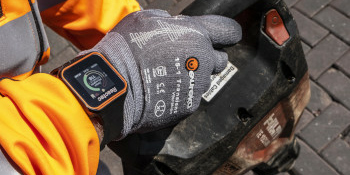
http://www.hse.gov.uk/pubns/books/l140.htm - Reactec’s HAVwear is a monitor of HAV daily exposure. It is not a test instrument such as a Larson Davis. It is intended to capture the data needed to understand an operator’s exposure through their entire working day. There is currently no standard for this type of device.
- There is no, currently available, “on tool” device designed to make tool vibration measurements over long periods of time without a technician, which fully complies with the requirements of ISO5349. An ISO5349 measurement requires accelerometers to be firmly affixed to the grip point of the tool and an expansive level of recorded measurement detail.
- Reactec’s HAVwear monitor gathers daily exposure data using two concurrent methods. One method (TEP) utilizes a fixed vibration magnitude which can be derived from an ISO5349-compliant measurement and is therefore in full compliance with the needs of the regulations and HSE guidance
- Reactec’s HAVwear monitor’s second method uses a real-time determination of vibration magnitude which through patented technology approximates the appropriate vibration level at the grip point. The variability from the approximation method is significantly better than the variability inherent in the range of possible tool vibration magnitudes between that established when an ISO5349-compliant measurement is taken and those from future use of the tool. See the IOM report.
https://www.reactec.com/iom_repor - There is legal precedence where Reactec’s data has been used to defend civil litigation cases. The key to a successful defence is in the management and control of HAV exposure, regardless of the method of assessing the exposure risk
- The HSE have conducted numerous inspections of organizations using Reactec’s HAVwear. The HSE have given positive feedback to organizations who have used the Reactec monitoring data to inform control measures for their employee’s risk
- The HSE have inspected Reactec and reviewed the capabilities of the HAVwear device and Reactec’s supporting guidance material. No issues have been reported.
It should be recognized by all that ISO standards, by default, are always behind technology advances. Also, that ISO standards are only ever developed to address a problem with current standards that needs to be solved. There is a growing body of international and independent evidence that wearable technologies can more directly assess the potential harm from exposure to vibration relative to traditional on-tool methods. At a meeting of the International working group on the human response to mechanical vibrations (ISO/TC108/SC4/WG3) August 2018 in Japan, an International expert group was established to develop a standard for wearable technologies.
To help clarify the apparent nuances of the bulleted list above, consider the role of a wrist-worn activity/heart rate monitor such as a Fitbit. You would not go to your GP and expect him to use such a device to measure your heart rate. You are aware that both the heart rate monitor and the counting of steps is a good estimate only. You use it to assess your overall level of activity day to day and your heart rate whilst you are doing higher risk activities such as long distance running, because you would not expect your GP to be available on a daily basis to check your health status. Do you have to wear one? No. Then why are they popular? Because they inform individuals in a way that allows them to make better decisions on how to manage their day to day fitness and health.