Every year, hundreds of workers in the UK develop Hand-Arm Vibration Syndrome — a permanent, irreversible condition caused by prolonged exposure to vibrating tools. The HSE estimates 2 million people in the UK are currently at risk, with 220 new cases assessed in 2024 alone (Source: IIDB). While irreversible, it is preventable.
For EHS managers and safety leads, that's a sobering reality — preventable conditions are still harming hundreds of workers every year. HAV exposure management is a legal requirement, but done well, it's also important to help protect the long-term health of your workforce and retain skilled employees. So, what does it actually involve, and where do most organizations fall short?
Want to skip ahead to the business case?
Download our whitepaper – The three Ps of HAV management: Profitability, productivity and paperwork
– to see how smarter monitoring can reduce costs and improve efficiency across your organization.
Download nowWhat is hand-arm vibration and why does it matter?
Hand-arm vibration (HAV) is the transmission of vibration through the hands and arms during the use of vibrating tools and equipment. Over time, repeated exposure causes Hand-Arm Vibration Syndrome (HAVS) – a collective term for painful and disabling conditions affecting the blood vessels, nerves, muscles and joints of the hand, wrist and arm.
HAVS is irreversible. Once fully developed, the vascular and neurological damage cannot be undone. Symptoms can begin to develop after months or years of exposure and typically worsen with continued use. Construction is one of the highest-risk industries, where musculoskeletal disorders account for 53% of all work-related ill health in the sector, with construction workers experiencing an MSD rate of 2.0% — statistically significantly higher than the all-industry average of 1.2%. Hand-arm vibration is specifically identified by the HSE as one of the key occupational conditions affecting construction workers (Source: HSE Construction Statistics in Great Britain, 2025). But construction is not alone — any industry where workers regularly operate power tools carries real and ongoing risk.
What does the law require?
The Control of Vibration at Work Regulations 2005 sets out clear legal duties for employers, centered on two key thresholds:
- Exposure Action Value (EAV): A daily vibration exposure of 2.5 m/s² A(8), at which employers must take action to reduce exposure.
- Exposure Limit Value (ELV): A daily vibration exposure of 5 m/s² A(8), which must not be exceeded.
Beyond adhering to these thresholds, employers are required to carry out risk assessments, implement controls, provide health surveillance and maintain appropriate records. Additionally, the HSE expects exposure values used in risk assessments to be representative of actual tool use by operators.
What does an effective HAV risk management involve?
Effective HAV management is an ongoing process, not a one-time task. It has several interconnected components.
Risk assessment is the foundation – identifying which workers are exposed to which tools, for how long and at what magnitudes. Real-world assessments need to account for operator technique, tool condition, grip force and other variables that laboratory measurements don't capture.
Exposure monitoring turns risk assessment from a snapshot into a living process. Tracking individual workers' actual exposure more regularly gives you the data to understand who is most at risk, which tools are the biggest contributors and where controls need to be strengthened.
Controls should follow the hierarchy of controls: eliminating vibration where possible, substituting high-vibration tools for lower-vibration alternatives, limiting exposure through job rotation and time-sharing and keeping tools properly maintained.
Health surveillance ensures early signs of HAVS are detected before irreversible damage occurs and that workers showing symptoms are promptly removed from high-risk activities.
Record-keeping and reporting ties everything together – providing evidence to demonstrate compliance, identify trends and make informed decisions about risk reduction.

Where traditional approaches fall short
Many organizations still manage HAVS risk using paper-based systems, manual timekeeping and estimates drawn from manufacturer tool data. This traditional approach creates challenges across three areas – profitability, productivity and paperwork.
Profitability:
Poor HAV exposure management carries the risk of direct costs in form of compensation claims, HSE fines and rising insurance premiums – as well as indirect costs from replacing skilled workers who can no longer operate their tools. Organizations that can demonstrate representative, evidence-based monitoring are in a much stronger position with insurers and in the event of litigation.
Productivity:
Without reliable individual exposure data, it's difficult to identify underperforming tools, optimize job rotation or find meaningful efficiency gains. Some organizations have reported workforce efficiency improvements of up to 25% simply by switching to automated data collection and reporting.
Paperwork:
The administrative burden of manual HAV management is considerable and the data it produces is often unreliable. As Gerry Kennedy, Roads Manager at AMEY North Lanarkshire, described it: "We relied on manual input, with a guy basically using his memory at the end of the day for the time that he has spent using vibratory tools." Roy Jackson, Senior Safety Advisor at BAM Nuttall, described their previous approach as "a lengthy and time-consuming process" that needed replacing. Paul Fleetham, National Contracting Director at Tarmac, is equally direct: "Paper-based systems never really worked" for them.
What good HAV risk management looks like
Effective HAV management replaces guesswork with evidence. It captures real exposure data at the individual worker level, in real time and makes that data accessible and actionable – so supervisors can intervene in a timely manner, problem tools are identified early and controls are refined based on what's actually happening on site rather than what's estimated.
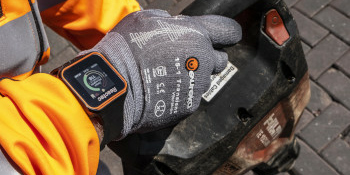
That's the foundation that Ideagen Reactec's R-Link wearable monitoring system is built on. Worn at the wrist, R-Link calculates and displays HSE exposure points in real time, alerts workers when they're approaching their personal thresholds and feeds data directly into the Reactec Analytics platform – giving employers a clear view of exposure across their entire workforce.
The impact is tangible.
“The data in Ideagen Wearable Safety Analytics is really useful for us to intervene before a worker reaches their exposure limit value.”
That's the difference between HAV management that looks good on paper and HAV management that genuinely works.